Implicit Panel Fields
Panels are represented with continuous boundary and seam-endpoint fields, giving the model a smooth space for topology-aware garment structure.
SIGGRAPH 2026
*Equal contribution †Corresponding author
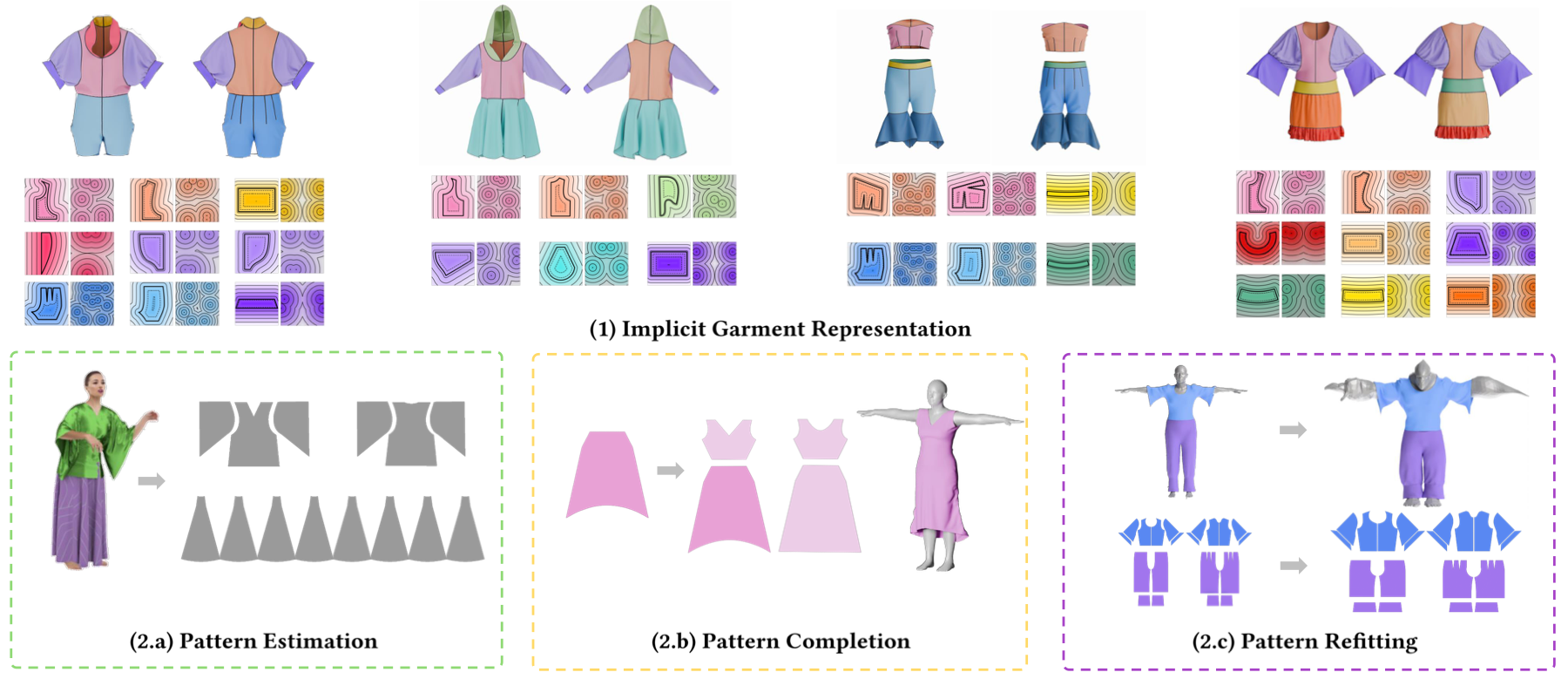
We learn sewing patterns as implicit fields in a latent flow matching framework, enabling pattern generation, image-to-pattern estimation, pattern completion, and refitting applications.
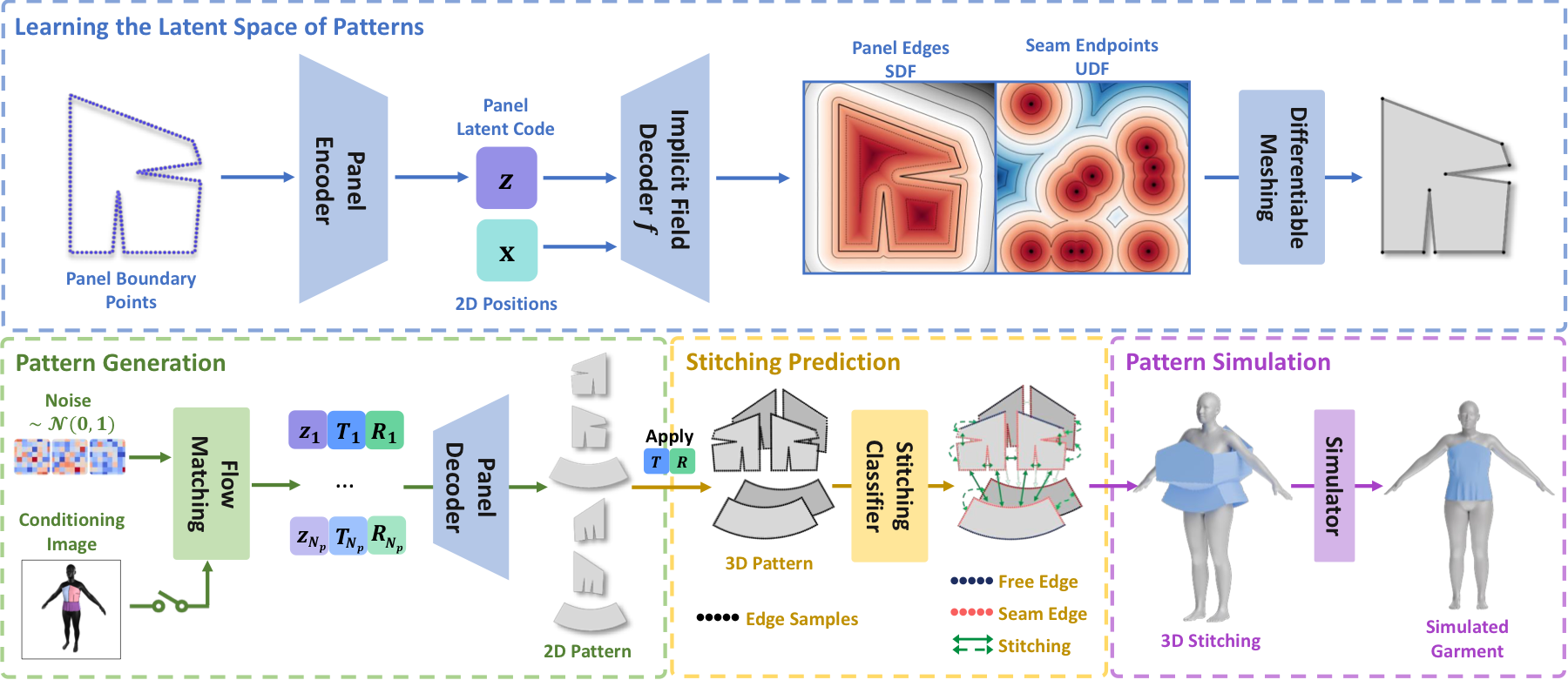
The pipeline learns panel latent codes through implicit fields, generates pattern layouts with latent flow matching, predicts stitching relationships, and simulates the completed garment.
Panels are represented with continuous boundary and seam-endpoint fields, giving the model a smooth space for topology-aware garment structure.
A generative flow model learns the distribution of panel combinations in latent space, enabling diverse sewing-pattern synthesis.
Extracted panel edges are paired by a stitching prediction module to recover seam relations and complete usable garment patterns.
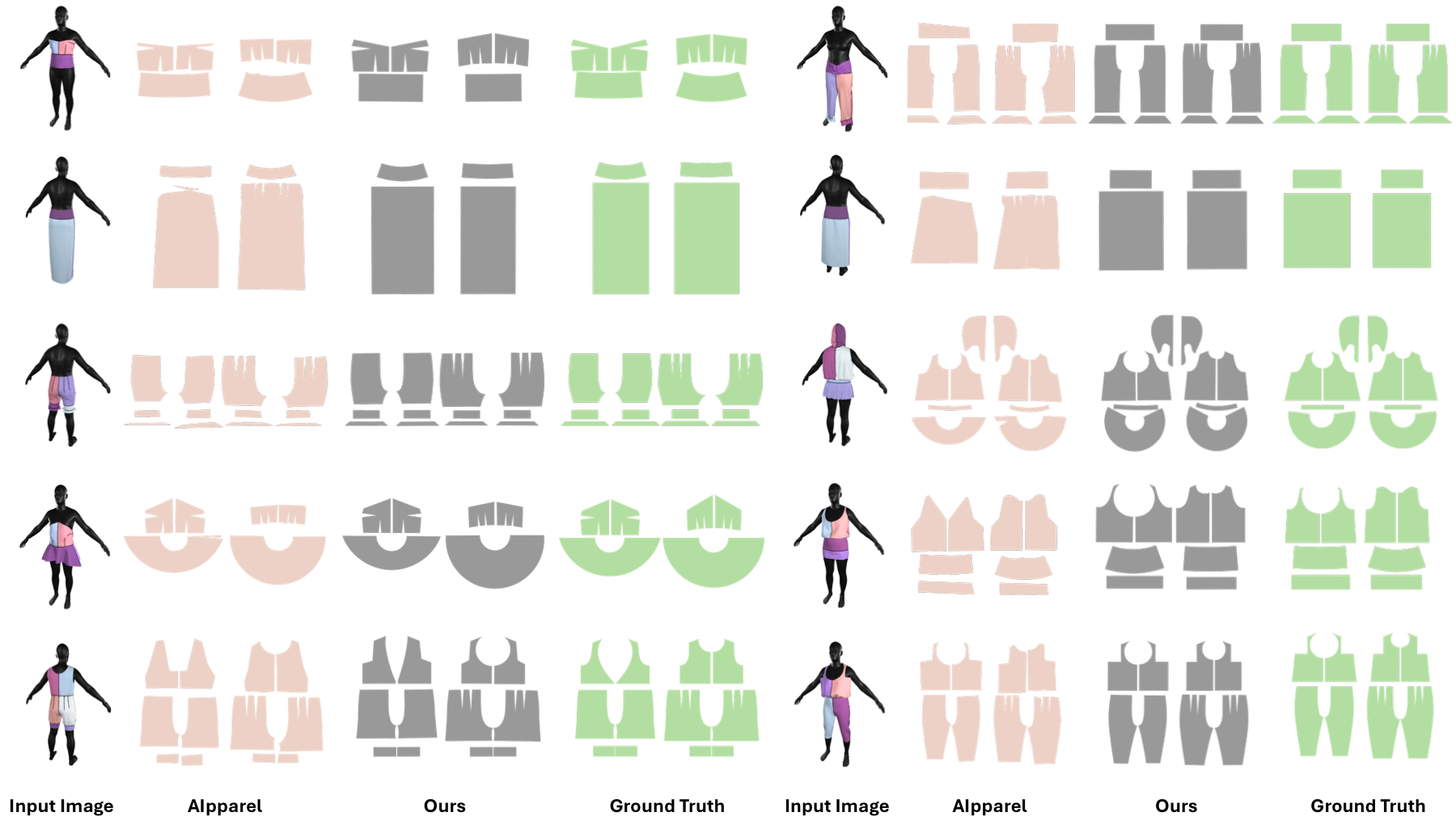
Given a dressed garment image, the method estimates the underlying sewing pattern. Compared with vector-based Apparel predictions, the implicit representation recovers panel shapes closer to the ground truth while ensuring garment-part structure to be valid.
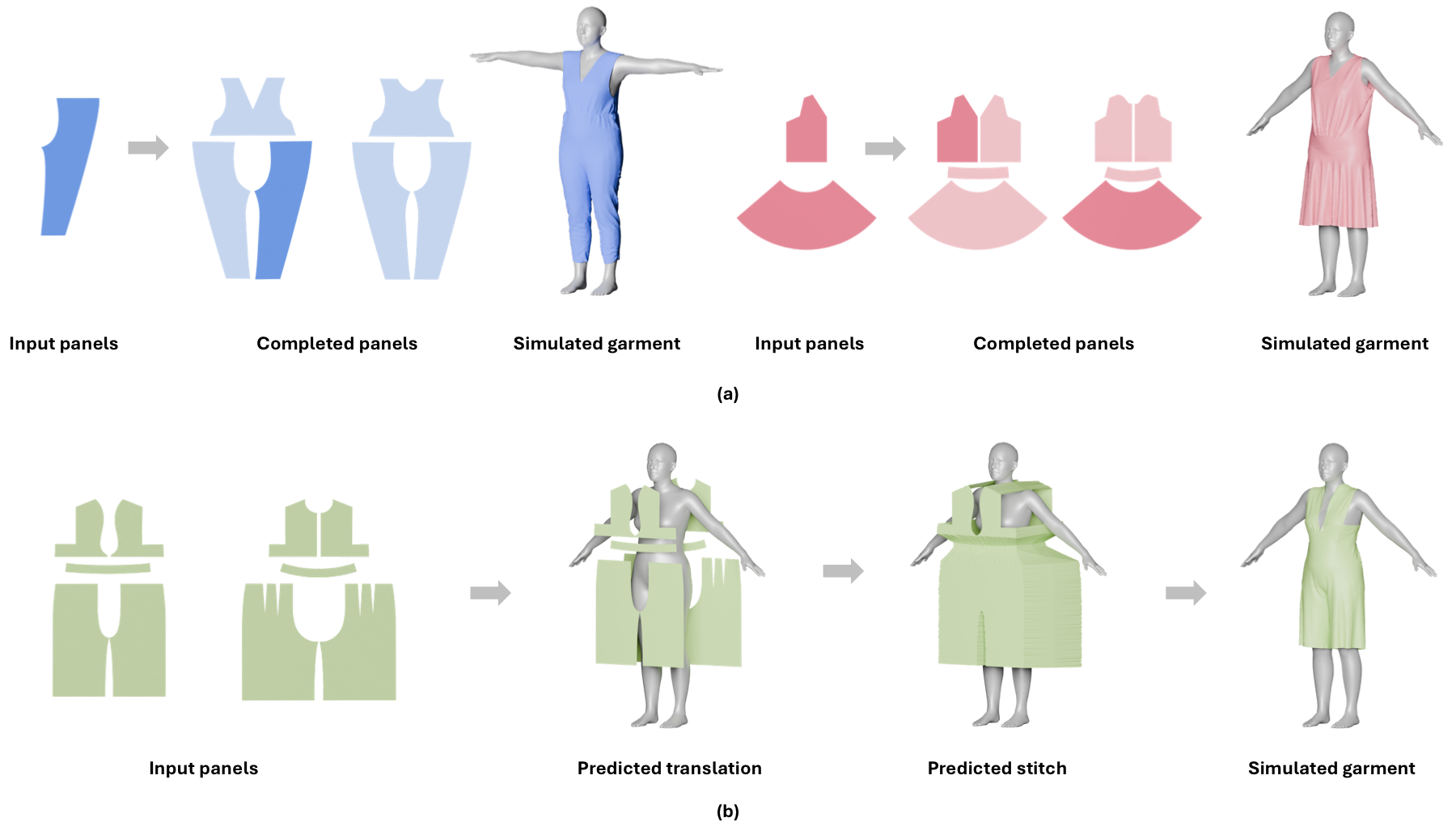
Starting from partial input panels, the model completes missing garment pieces, predicts compatible panel translations and stitches, and produces complete patterns that can be simulated as dressed garments.
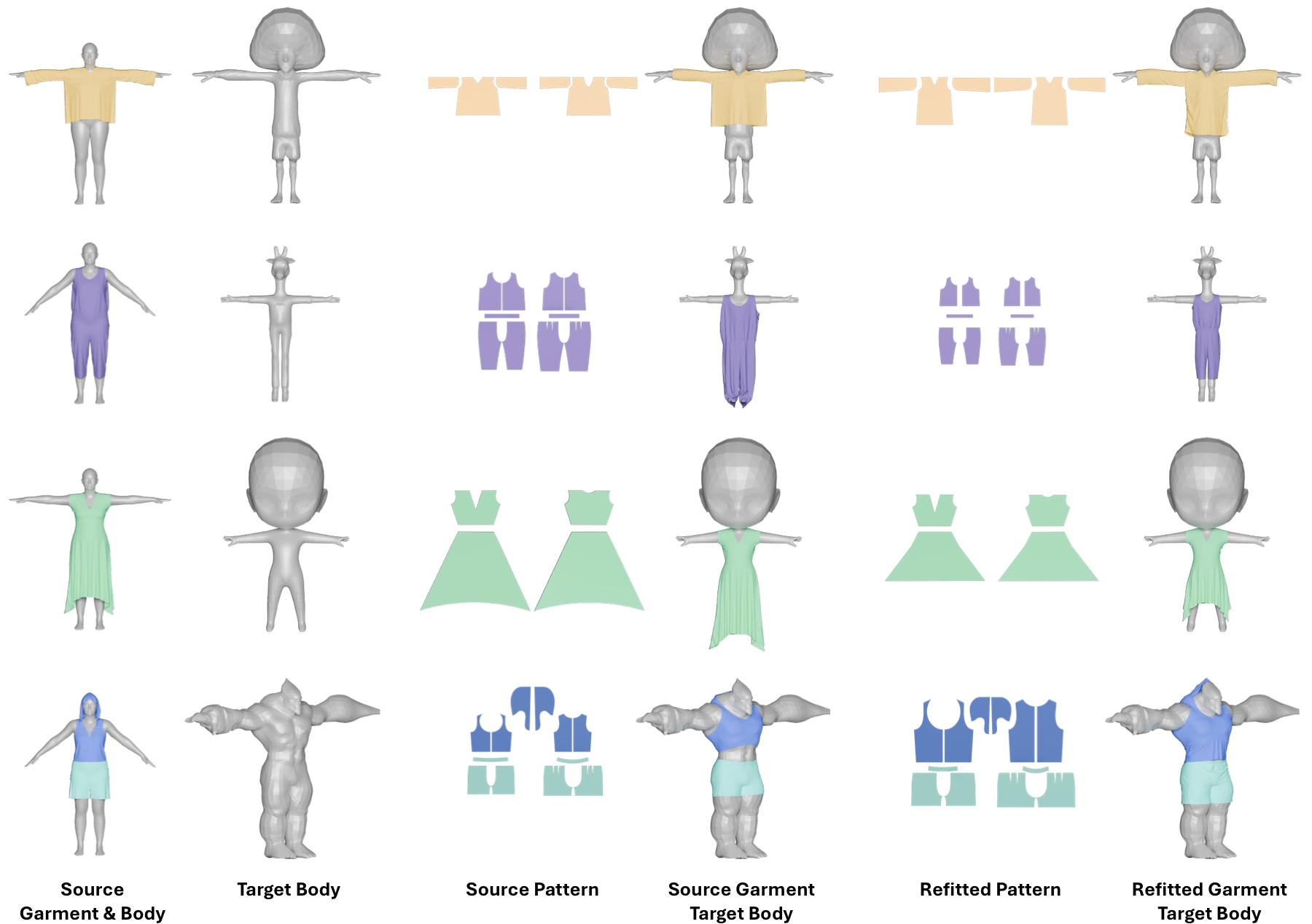
Given a source garment and body, the learned pattern space supports refitting to a different target body by adapting the sewing pattern while preserving the garment style and enabling simulation on the new shape.
@article{cao2026learning,
  title   = {Learning Sewing Patterns via Latent Flow Matching of Implicit Fields},
  author  = {Cao, Cong and Li, Ren and Dumery, Corentin and Li, Hao},
  journal = {arXiv preprint arXiv:2601.17740},
  year    = {2026}
}